Automation Is Only the Beginning
In Part 1, we looked at why businesses need to move away from manual processes and how automation can improve productivity.
But there is another important step.
Once processes become digital, businesses start generating better and more structured data. And that data creates a new opportunity: Making better decisions.
The journey becomes:
Manual → Digital → Automated → Connected → Data-Driven → Intelligent
From Data Entry to Data-Driven Operations
When information is scattered across spreadsheets, emails and different systems, it is difficult to understand what is happening across the organization.
An integrated digital environment changes that.
For example:
Sales → Customer Data
Inventory → Stock Data
HR → Workforce Data
Operations → Process Data
Finance → Financial Data
When these systems are connected, management gets a more complete picture of the business.
Instead of asking: “Can someone prepare a report?”
managers can ask: “What is happening right now?”
Real-Time Visibility Changes Decision-Making
Imagine a business that receives performance reports only at the end of the month.
By then, problems may already have become expensive.
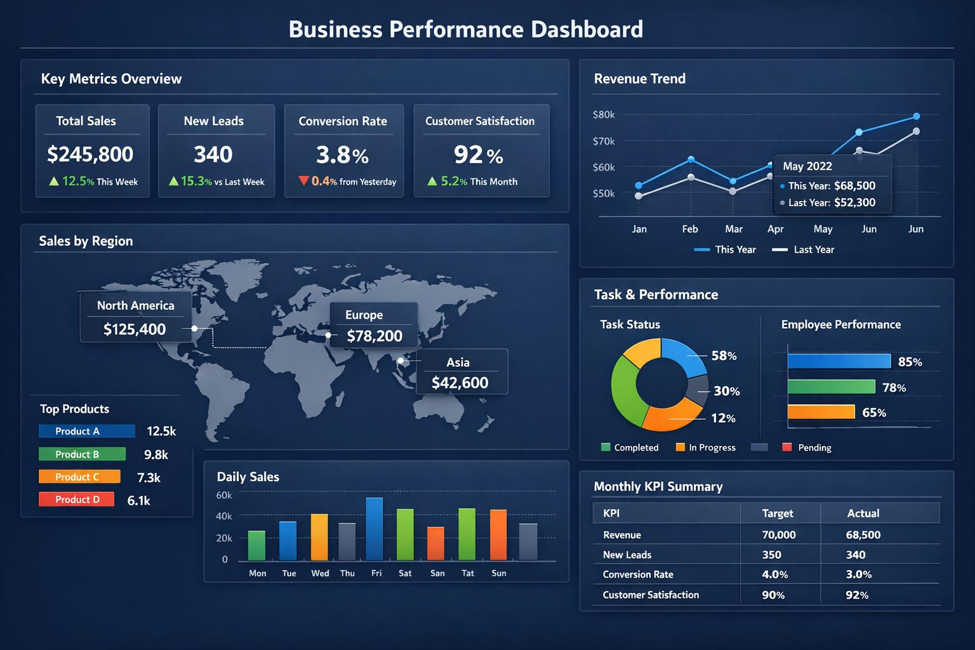
Now imagine management can monitor key information in real time.
If sales increase, inventory requirements can be identified earlier.
If production falls behind, managers can respond sooner.
If costs begin increasing, the trend can be investigated before it becomes a serious problem.
This creates a fundamental shift:
Traditional systems tell you what happened. Smart operations help you understand what is happening and where to act.
Dashboards Should Drive Decisions
A dashboard isn't valuable simply because it looks impressive.
It needs to answer important business questions.
A CEO may want to know:
Are we meeting our targets?
Which areas need attention?
What are our biggest operational risks?
An operations manager may need:
Productivity
Pending tasks
Delays
Resource utilization
An HR manager may monitor:
Attendance
Workforce availability
Overtime
Employee trends
A finance team may track:
Revenue
Expenses
Receivables
Cash flow
The best dashboards put relevant information in front of the people who need to act on it.
KPIs: Measuring What Actually Matters
Becoming data-driven doesn't mean measuring everything.
It means identifying the metrics that matter.
Depending on the organization, these could include:
Productivity
Turnaround time
Sales conversion
Customer retention
Inventory turnover
Employee attendance
Operating costs
Profit margins
On-time delivery
Error rates
The important question is: “If this number changes, does it affect a business decision?”
If the answer is no, it may not need to be a KPI.
From Reactive to Proactive
Once businesses have reliable data, analytics can help identify patterns.
For example:
Sales declining → Identify trend → Investigate cause → Take action
Or:
Inventory declining → Forecast requirement → Reorder → Avoid shortage
This is the beginning of predictive operations.
Instead of waiting for problems to happen, businesses can use historical and real-time data to identify potential risks earlier.
The Next Step: AI and Intelligent Operations
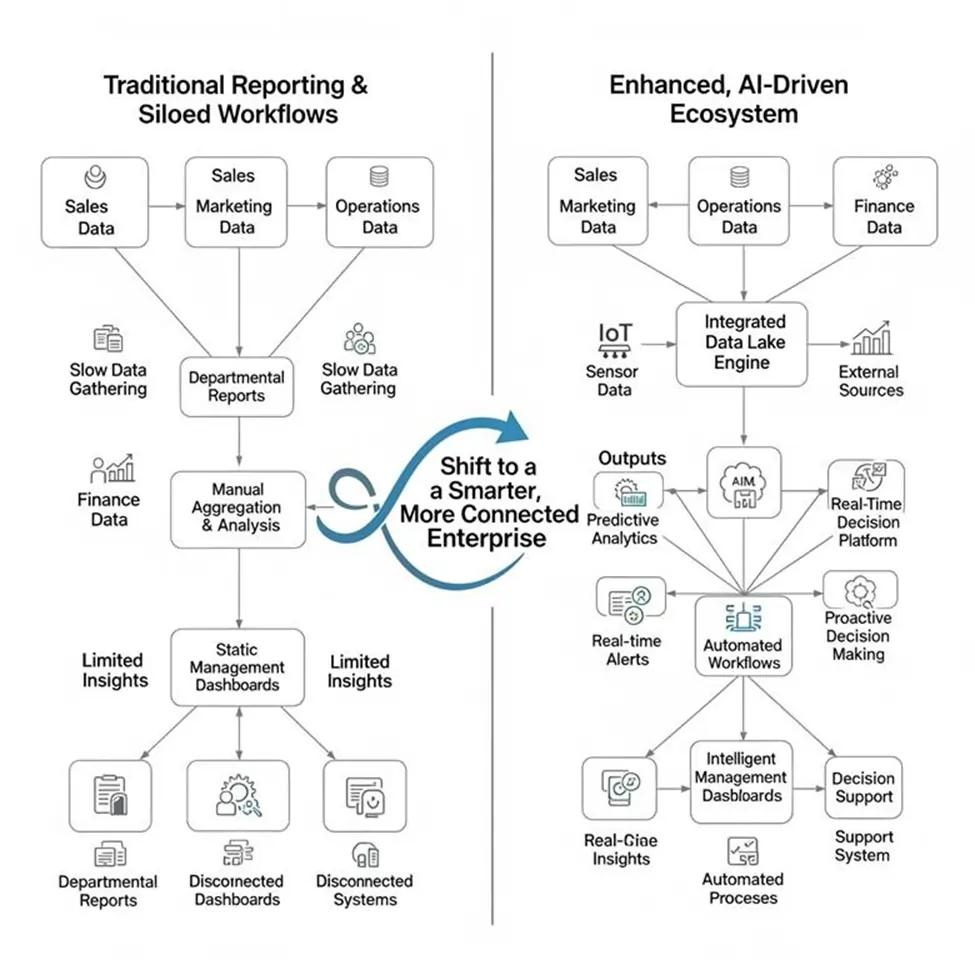
The next stage of digital transformation is increasingly being shaped by artificial intelligence.
AI can potentially help businesses:
Forecast demand
Identify unusual patterns
Predict operational risks
Analyze customer behavior
Automate management reports
Recommend actions
Improve resource planning
Imagine a management system that doesn't simply show that sales are declining but highlights which products, locations or customer segments are driving the decline.
That's a very different level of business intelligence.
Building a Smart Operations Roadmap
Businesses can approach transformation in stages:
1. Identify
Find inefficient or repetitive processes.
2. Simplify
Remove unnecessary steps.
3. Digitize
Move processes into digital systems.
4. Automate
Reduce repetitive manual work.
5. Connect
Integrate information across departments.
6. Analyze
Introduce dashboards and meaningful KPIs.
7. Predict
Use analytics and AI to identify future risks and opportunities.
The goal isn't technology for its own sake.
The goal is better business performance.
The Real Value of the Digital Shift
Digital transformation is sometimes presented as a technology project.
In reality, it is a business improvement project supported by technology.
The real benefits are:
· Less repetitive work.
· Fewer errors.
· Faster processes.
· Better visibility.
· Smarter decisions.
· More productive employees.
· Greater agility.
And perhaps most importantly, businesses become better prepared to adapt when markets, customers and technologies change.
The Future Belongs to Businesses That Can Adapt
The smartest organization won't necessarily be the one with the most software.
It will be the one that can:
Understand its operations → Learn from its data → Respond quickly → Continuously improve.
That's the real meaning of smart operations.
The shift from manual processes to digital operations is not a single project with a finish line.
It is an ongoing journey of improvement.
And every business can start with one process.
How Skylark Can Help
At Skylark, we help businesses move from disconnected, manual processes toward integrated and data-driven operations.
Through ERP, HRMS, workflow automation, business intelligence and industry-focused digital solutions, businesses can digitize everyday processes, connect information and gain better visibility into their operations.
Whether you're starting with one manual workflow or planning a broader digital transformation, the journey starts by identifying where technology can create the most meaningful business impact.